GEORGIA
GEORGIA
Georgia is a recent newcomer to our earth’s 6-billion-year history! For the past 65 million years, our “Peach State” was covered by the ancient beginnings of our Atlantic Ocean. Many different species of sharks, including the goblin, mackerel, sand and tiger sharks swam all around this area.
Since a shark’s skeleton is made up of cartilage, very few fossil shark skeletons have been found. But shark teeth literally come from a fossil factory! Just like the Ford Company’s assembly line, a shark’s mouth has rows of teeth waiting their turn to be brought to the front of its mouth. Most sharks have 3-5 rows of teeth in their jaws every day! We brush our teeth every day to keep them clean and healthy. Some species of sharks replace their cracked, decayed or worn-out teeth every 7-8 days. Look Ma, no cavities!
Teeth are made of dentine which is one of the hardest organic (natural) materials we know of. This means that the worn-out teeth that the sharks discard will be well preserved fossils for us to find. The size of these teeth ranges from less than an eighth of an inch to the incredible 6.5-inch megalodon teeth.
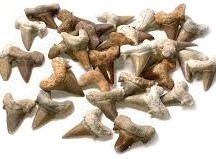
Assorted Shark Teeth
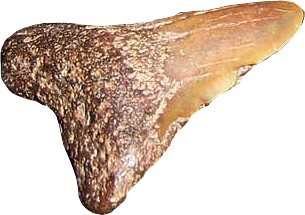
Megalodon Shark Tooth
On my last trip down to Georgia to see family, three of us gals decided to go fossil hunting. So early one morning, Beth, Jen and I set off for Shark Tooth Island on the Savannah River. We were close to home, but the car was packed with sunscreen, water bottles, collection bags and plenty of towels. Did I mention that this is very messy. You literally spend hours walking around in mud during low tide. It brought back wonderful memories of my mom shaking her head and grabbing the back of our t-shirts as she led my brother and I to the bathtubs. Mike and I always were the type of kids that liked to get dirty!
Shark Tooth Island is just west of Tybee Island and that area had just been dredged somewhat recently. It was now low tide, and we took a boat out with about 10 other people. You could see the entire island now that the tide was low. At high tide, sometimes you couldn’t even see the island. The tides rise to ten feet!
Our group would be staying on the island for 3 ½ to 4 hours as the tide came in. OK, it’s time to get good and dirty. We chose an area, spread out a little from each other and just kept looking for fossil shark teeth. Perhaps one of us would find a megalodon tooth. Perhaps…
Well, we found a tooth and compared it to the index card that the captain had given to each of us. Let us know what you think!!
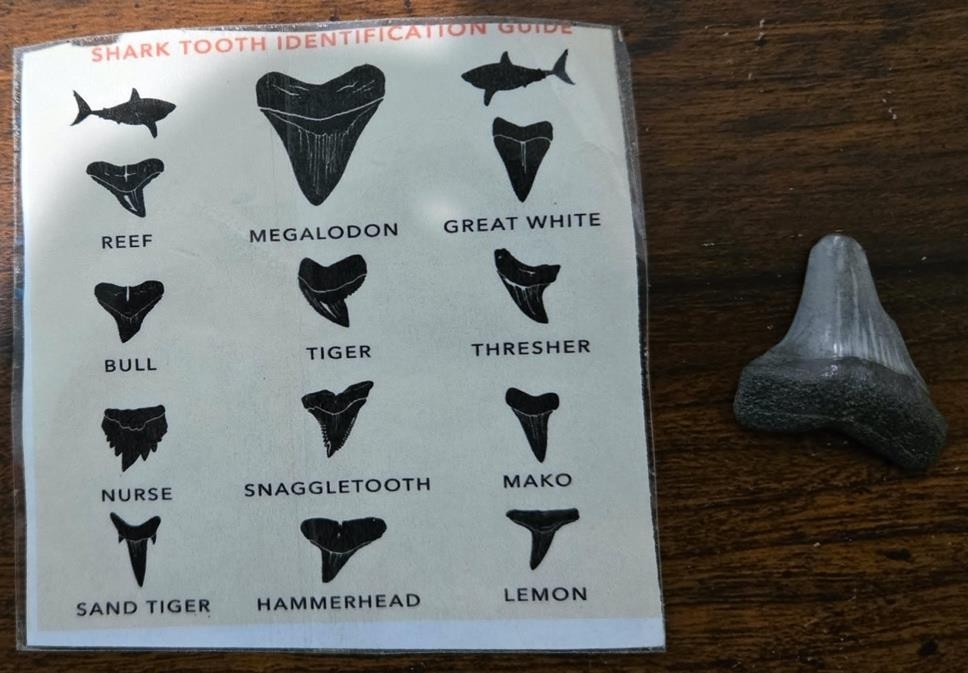
(photo Copyright Beth Ronberg)
The best places to look for shark teeth are along the coastal plain area. This is a section of land that extends over most of the southern part of Georgia. Some of the best collecting areas can be found in Richmond County. Eocene sediments near Fort Gans and Americus, Miocene Sediments near the Savannah River, near Porter’s Landing and Forest Falls Sink. There are other sites as well. Just ask around when you’re in the area.
So, where do you go if you don’t want to get all muddy and mucky hoping to find possible shark teeth? Well, you can visit these locations instead. The state of Georgia has lots to offer.
GEORGIA MUSEUMS WITH DINOSAUR, SHARK, ROCK & FOSSIL EXHIBITS
MUSEUM OF ARTS AND SCIENCES
4182 Forsyth Rd. Macon GA 31210 (478) 477-323
Established in 1956, the Museum of Arts and Sciences in
Macon is Georgia’s largest institution devoted to the arts and sciences.
The museum’s natural science collection includes rocks, minerals, shells, and a 40- million-year-old whale fossil, Zygorhiza, or Ziggy, which was discovered at a local mine. Ziggy was found by a local paleontologist and “rockhound”, Bill Christy. A retired railroad hand, Christy made his big find in 1973. Ziggy turned out to be larger than anyone thought. Way larger! With the help of scientists from the University of Georgia, they excavated the 18-foot long Zygorhiza.
Ziggy was stored away again for several years until Christy learned that the Museum of Arts and Sciences was going to expand its building. Money was then raised for a permanent exhibit! They say that this may be the largest full Zygorhiza skeleton found anywhere in the world. While there weren’t too many other dinosaur exhibits when my family was there, just seeing Ziggy was worth the visit.
They also have a multidisciplinary facility housing art and science galleries, a planetarium with an observatory, the three-story interactive Discovery House, a very nice live-animal complex, nature trails, and an off-site nature preserve.
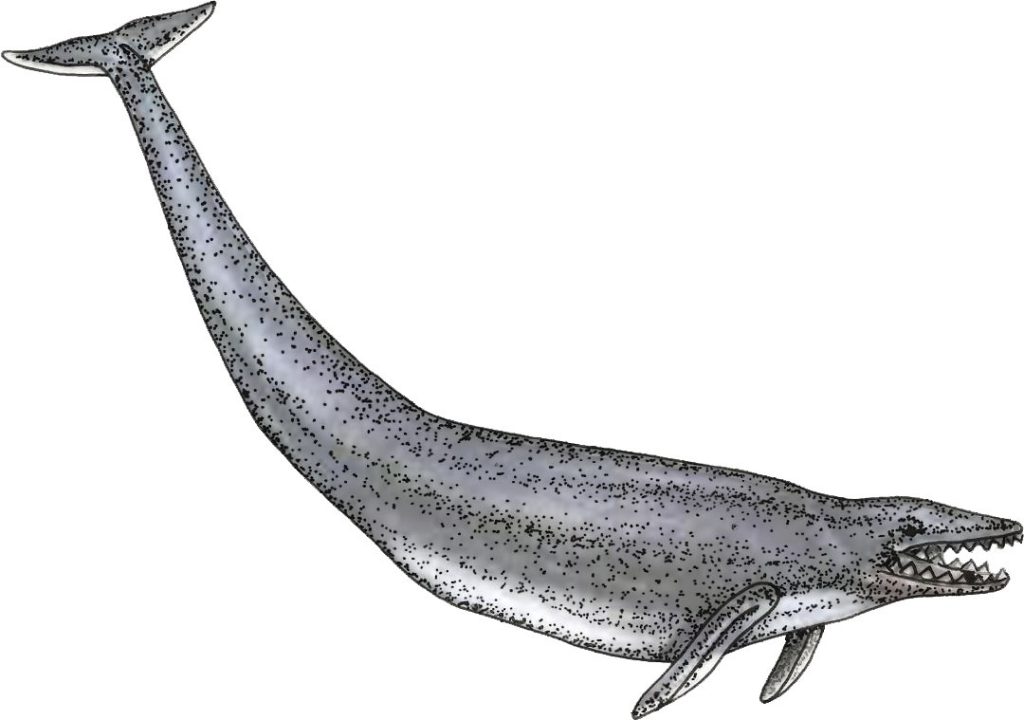
(Copyright Deborah Balke Lindner)
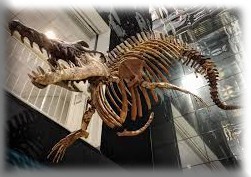
Thanks to The Museum of Arts and Sciences

Live at the Nature Preserve
WEST GEORGIA MUSEUM OF TALLAPOOSA
185 Mann St., Tallapoosa GA 30176. (770) 574-3125
I have never visited this museum, but from everything I have read, this is a wonderful place to visit. This small textile town in northwestern Georgia may have one of the most interesting museums that you will ever visit. This small-town museum is about as close as you will get to traveling through time.
The West Georgia Museum says: We have an extensive dinosaur collection featuring a 30- foot T-Rex, plus a huge exhibit of Creek Indian artifacts. For bird lovers, we have a special bird room featuring over 200 mounted birds. Also, we have a special exhibit of Tallapoosa’s old gold mine.
This Museum has something for all ages. A look back to the late 1800 early 1900 era, including replicas of old stores, a barber shop and a bank, will take you back to an earlier time.
For the youngsters a whole assemblage of dinosaurs greets visitors as they enter the museum. With a 30ft. Tyrannosaurus Rex towering over seven other smaller dinosaurs, it is indeed an awesome sight that will inspire young, inquisitive minds.
The Museum says, “1920s shops are just the start. Native culture is lovingly represented with an entire wing of Cree tapestries, clothing and artifacts. Your time machine will take you further back with prehistoric mammals and dinosaurs painstakingly recreated by a local taxidermist and namesake of Bud Jones Taxidermy. Alarge portion of the museum is dedicated to his ongoing work, with samples of seemingly every bird that has existed in the region, great and small.”
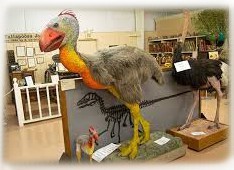
Don’t be a Dodo Bird, visit museums – You never know what’s around the corner!
FAIRBANK MUSEUM OF NATURAL HISTORY
767 Clifton Road NE, Atlanta, GA 30307. (404) 929-6300 www.fernbank.edu
The Fernbanks Museum of Natural History opened in 1992 and is Atlanta’s biggest natural history museum. Their ad says, “Travel around the world and back in time as you discover dinosaurs, live animals, amazing places, ancient fossils, prehistoric cultures and new science discoveries. ”My family hasn’t visited this museum just yet. We are waiting for the younger kids to get just a little bit older, both for the ride and the museum adventure.
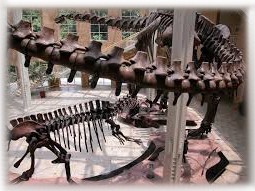
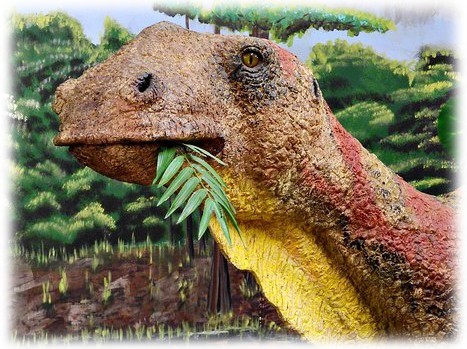
Fernbank Museum of Natural History
This museum offers Colossal Fossils! The Giants of the Mesozoic exhibit is set up in the Great Hall. The exhibit features full scale fossil replicas of the giant Appalachian Giganotosaurus and the mega sauropod Argentinosaurus.
The Giganotosaurus is hunting the Argentinosaurus, with a fallen Auracaria tree and fossilized crocodilian. Cast replicas of 24 pterosaurs are strung up above. From what I see on their web page, this looks amazing.
FAIRBANKS SCIENCE CENTER
156 Heaton Park Dr., Atlanta GA 30307 (678) 874-7102
The Fairbank Science Center, located in Atlanta, Georgia, is a unique educational facility offering a combination of urban forest, planetarium, observatory, an exhibit hall, laboratories, and a 65-acre forest for exploration.

Fairbank Science Center
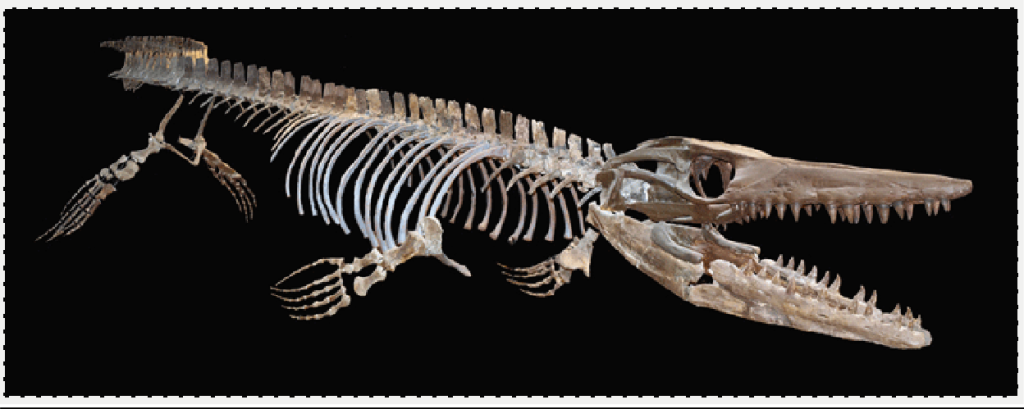
Georgia Southern University Museum
GEORGIA SOUTHERN UNIVERSITY MUSEUM
2142 Southern Drive , Statesboro GA 30458. (912) 478-1149
This is from their internet site, “Welcome to the Georgia Southern Museum where collections, exhibits, and programming interpret the natural and cultural history of Georgia’s coastal plain and the exciting research and work taking place at Georgia Southern University. The shallow ancient oceans that swept back and forth for millions of years formed this unique region. The Museum’s permanent exhibits tell the story of the coastal plain’s changing environments, animals, and cultures that have called it home.”
ROCK EAGLE EFFIGY MOUND
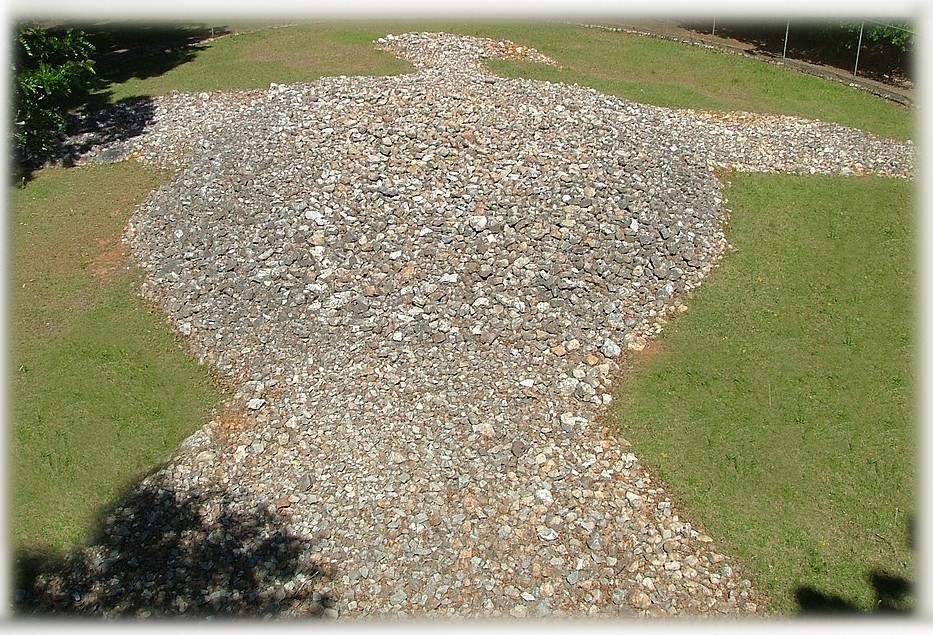
Rock Eagle Effigy Mound is an archaeological site in Putnam County. Scientists estimate that it was constructed about 1,000 to 3,000 years ago. The Rock Eagle was built from thousands of pieces of quartzite laid in the mounded shape of a large bird. It is 102 ft long from head to tail, and 120 ft wide from wing tip to wing tip. Although it is most often referred to as an eagle, scientists do not know exactly what type of bird the original builders tried to portray. It is listed on the National Register of Historic Places because of its significance. The University of Georgia takes care the site. It uses much of the adjoining land for a 4-H camp, with cottages and other buildings. Visitors are permitted to visit the mound free of charge. The site is located adjacent to State Route 441 between the cities of Madison and Eatonton.
I am a former 4-H member and thought this site looked great. You can the entire mound but are not allowed to touch it. It is protected by a large fence. The Diane Davies Natural History Museum is located here as well.